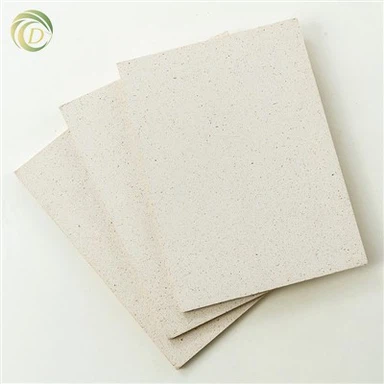
Raw Materials for Magnesium Oxide Board (MGO Board)
Aug 03, 2026

MGO board, also known as magnesium oxide board, magnesium oxysulfate board or magnesium oxychloride board, is a new type of inorganic fireproof building board. Its performance, stability, anti-efflorescence strength and service life are directly determined by raw material selection, mixing ratio and raw material quality indicators. Below is a detailed classification and introduction of all key raw materials.
1. Main Raw Materials (Mineral Binder System)
1.1 Light Burned Magnesium Oxide (Caustic Calcined Magnesia, CCM / MgO)
Chemical Formula: MgO
Production: Produced by low-temperature calcination (600–800℃) of magnesite ore.
Core Indicator: Active magnesium oxide content (critical index, normally required ≥60% for qualified board production).
Function: The core gelling component. It reacts with magnesium salt solution to form magnesium cement crystalline phase, providing initial strength and structural stability of the board.
Notes: Over-burned MgO reduces activity and leads to incomplete hydration; under-burned material causes excessive heat release, board deformation and cracking. High impurity content (CaO, SiO₂) will worsen anti-hydration performance.
1.2 Magnesium Salt (Two Main Technical Routes)
Route A: Magnesium Chloride (MgCl₂, Magnesium Chloride Solution)
Raw material for traditional magnesium oxychloride cement boards.
Advantages: Low cost, fast curing speed, high early strength.
Defect: Free chloride ion easily causes halogenation (efflorescence) and corrosion of metal fasteners.
Route B: Magnesium Sulfate (MgSO₄, Epsom Salt)
Raw material for magnesium oxysulfate boards (low-halogen, high-end MGO boards).
Advantages: No chloride ions, effectively avoids efflorescence and metal corrosion; better dimensional stability.
Disadvantages: Slower curing, higher production technical requirements, higher raw material cost.
Definition: The mixture of active MgO + magnesium salt aqueous solution is called magnesium cement matrix, the fundamental skeleton of MGO board.
1.3 Filler Materials (Aggregate & Functional Fillers)
(1) Talcum Powder
Mainly reduces system shrinkage, improves surface smoothness of boards, optimizes processing fluidity.
(2) Fly Ash / Silica Fume
Industrial supplementary cementitious materials. Improve compactness, reduce raw material cost, enhance water resistance and long-term stability.
(3) Calcium Carbonate (Limestone Powder)
Common low-cost inert filler, adjusts density, reduces material cost. Excessive addition reduces flexural strength.
(4) Perlite / Vermiculite
Lightweight porous filler. Used to produce lightweight MGO boards, reduce bulk density, improve thermal insulation and sound absorption performance.
2. Reinforcement Materials
2.1 Glass Fiber Mesh (Fiberglass Mesh Cloth)
Alkali-resistant glass fiber mesh is the standard reinforcement material.
Function: Prevent brittle fracture, improve flexural strength, resist crack propagation.
Specification: Normally 80–160g/㎡. Ordinary non-alkali-resistant mesh will be eroded by alkaline magnesium cement and lose strength over time.
2.2 Wood Fiber / Sawdust / Plant Fiber
Light organic filler. Reduce board density, improve toughness, lower thermal conductivity. Limitation: Excessive fiber will reduce fire resistance and cause moisture deformation.
3. Functional Chemical Additives (Critical Auxiliary Materials)
Additives are generally added in small dosage (0.3%–3% of total raw materials), but decisive for product quality.
Water Resistance Agent: Improve the water resistance of magnesium cement, reduce strength attenuation under humid environment.
Anti-halogenation Agent (Efflorescence Inhibitor): Block free ion migration, solve surface whitening, weeping salt problems.
Retarder / Accelerator: Adjust curing reaction speed, control exothermic peak, avoid board bulging, warping.
Dispersant: Optimize slurry fluidity, facilitate forming, reduce internal voids.
Foaming Agent: For lightweight foamed MGO boards to form closed pores and realize thermal insulation.
4. Water
Industrial clean water is required. Impurity ions in wastewater will interfere with the hydration reaction of magnesium cement, easily triggering unstable crystallization, efflorescence and strength decline.
Supplementary Key Technical Summary
The most critical matching relation: Active MgO content + Mg²⁺ molar ratio; improper ratio is the primary cause of board warping, cracking, moisture absorption and efflorescence.
Raw material difference divides product grades:
Low-end: Magnesium chloride system + low-activity MgO
High-quality environmental board: Magnesium sulfate system + high-activity light burned MgO + anti-efflorescence additives
Quality chain: Raw material indicators → formula ratio → curing process → final physical properties (fire resistance, strength, water resistance, dimensional stability).