


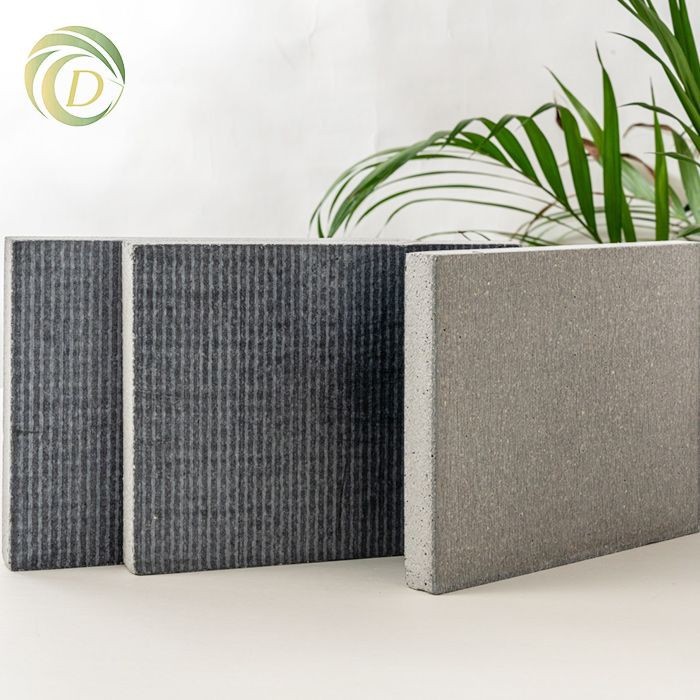


High Impact Resistant Board
The high impact resistance of MgO boards stems from the synergy of "rigidity from inorganic cementitious materials + toughness from fiber reinforcement + high-density structure," making them excel in scenarios requiring resistance to impact and vibration. With added fire and moisture resistance, they are a durable choice for industrial and construction applications.
- Fast Delievery
- Quality Assurance
- 24/7 Customer Service
Product Introduction

Product Introduction
The high impact resistance of magnesium oxide (MgO) board, a high-performance cement panel, stems from the scientific design of its material structure and production process. The following analysis unfolds across multiple dimensions:
I. Material Composition: The Hardcore Foundation for Impact Resistance
1. Rigid Support from Inorganic Cementitious System
Magnesium oxide board uses magnesium oxide (MgO), magnesium chloride (MgCl₂)/magnesium sulfate (MgSO₄), and water (H₂O) as primary raw materials to form a magnesia cementitious material. After hardening, its crystal structure is dense, with a compressive strength of 60–80 MPa (far exceeding the 10–20 MPa of ordinary gypsum board), enabling it to resist deformation under external impact.
2. Toughness Enhancement from Reinforcing Fibers
Medium-alkali glass fiber mesh cloth or plant fibers are incorporated into the board, creating a "rigid-flexible combination" structure: the fibers act as a skeleton to disperse impact force and prevent cracking. For example, glass fibers have a tensile strength of over 1,800 MPa, effectively blocking crack propagation.
II. Structural Design: Impact Resistance Optimization via Density and Thickness
1. High-Density Compact Structure
Common magnesium oxide boards have a density of 0.9–1.25 g/cm³. Through roll-pressing forming technology, their internal porosity is low, and intermolecular bonding is strong. Ordinary gypsum board has a density of about 0.9 g/cm³, with lower compactness and a weaker internal structure. At the same thickness, the impact resistance of magnesium oxide board is 3–5 times that of gypsum board.
2. Thickness Flexibility to Meet Demands
Common thicknesses range from 3–20 mm. For instance, a 12-mm-thick magnesium oxide board can withstand the impact of a 5-kg sledgehammer falling from a height of 1.5 meters (tested per GB/T 23451-2009) with no obvious cracks on the surface, whereas a wooden board of the same thickness may be damaged.
III. Physical Properties: Impact Resistance Data and Scenario Validation
1. Performance Indicators
|
Performance |
Magnesium Oxide Board Parameters |
Comparison Material (Gypsum Board) |
|
Flexural strength |
≥12 MPa (horizontal) |
≤8 MPa |
|
Impact absorption energy |
15–20 J/m² (10-mm board) |
5–8 J/m² |
|
Weather resistance impact test |
No cracking after 50 cycles at -20°C to 60°C |
Brittle at low temperatures |
2. Typical Application Scenarios
|
Application Scenario |
Impact Resistance Example |
Performance of Comparison Material |
|
Industrial plant partition walls |
Withstands equipment vibration and forklift collisions |
Prone to cracks and damage |
|
Commercial space ceilings |
Resists accidental impacts (e.g., falling objects) |
Prone to collapse after impact |
|
Underground parking lot walls |
Withstands vehicle scratches and heavy object collisions |
Requires frequent maintenance |
IV. Extended Value of Impact Resistance Advantages
1. Dual Protection of Fire Resistance and Impact Resistance
Magnesium oxide board is a Class A1 non-combustible material. It does not soften at high temperatures, thus maintaining its impact resistance. For example, in fire scenarios, it can still retain structural integrity, outperforming combustible wooden boards.
2. Moisture Resistance and Deformation Prevention to Maintain Impact Stability
Qualified magnesium oxide boards have a moisture content ≤8%. They can maintain stable flexural strength in 90% humidity environments (gypsum board's strength decreases by over 30% when damp), avoiding impact resistance degradation due to deformation.
Parameters:
|
Main Materials |
MgO, MgCl2/MgSO4, Glass fiber Mesh |
|
Fire Performance |
Non-combustible, No flame spread, No smoke spread,No poisonous gas |
|
Density |
0.9-1.35kg/m3, |
|
Flexural Strength |
10-40Mpa |
|
Impact Strength |
≥3.5 kJ/m2 |
|
Moisture Content |
≤8% |
|
Shrinkage |
≤0.3% |
|
Swelling |
≤0.3% |
|
Screw Holding Capacity |
30-120/(N/mm) |
|
Leachable Chloride |
0.1%(MOS),3%(MOC) |
|
Edge |
Square/T&G/Tapered/Beveled |
|
Thickness |
6-20mm |
|
Standard Sizes |
4*8ft/1.22*2.44m(Other sizes can be customized) |
|
Production Capacity |
5000 square meters / day |
|
Remark |
The above parameters are acceptable to ODM |


Workshop Information:

Why Choose Us
As the Chair of the International Exchange Committee at the China Magnesium Materials Association (CMMA), we are actively advancing the global use of MGO board as a durable, eco-friendly building material.
We work closely with international organizations such as the Magnesium Oxide Building Materials Association (MgOBPA) and the Magnesium Oxide Association (MOCA) to raise awareness, ensure consistent product quality, and support innovation in the magnesium oxide building materials sector.
Our involvement in standard development spans both national and international levels. We participate directly in the work of the American Society for Testing and Materials (ASTM), contributing to the creation of industry standards. These efforts reflect our long-term commitment to building a standardized, globally integrated, and quality-driven MGO industry.
Core Product Portfolio
Magnesium Oxide (MgO) Boards for construction applications
Laminate panels with MgO cores, engineered for furniture and decorative finishes
Packing and Shipping for High Impact Resistant Board:
We pay attention to our package to insure the board will be very well protected during transportation.

FAQ:
Q1: How are your boards packaged?
A: Our products are securely packed on heavy-duty plywood pallets to ensure damage-free transit.
Q2: What are your payment terms?
A: We require 50% deposit via T/T, with the remaining balance due prior to shipment.
Q3: What is your typical delivery timeline?
A: Production generally requires one month after deposit confirmation. Final delivery schedules vary based on order quantity and specifications.
Q4: Can you manufacture products based on provided samples?
A: Yes, we offer custom production according to samples. Special requirements can be accommodated through dedicated formula development.
Q5: Do you provide product samples?
A: Complimentary samples are available upon request.
Q6: Is quality testing performed before shipment?
A: Two-stage quality assurance is implemented:
Laboratory batch testing
Individual board inspection before palletizing
Hot Tags: high impact resistant board, China high impact resistant board manufacturers, suppliers, factory, Termite Proof Subfloor, Fire Proof Subfloor, Termite Resistant Subfloor, Fire Resistant Subfloor, Fire Rated Flooring Board, Mgo Flooring


