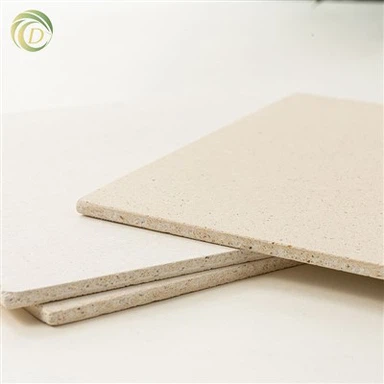
Building A Strong Fire Barrier: Magnesium Oxide Board Guards Safety With Excellent Performance
Apr 13, 2026
With the continuous improvement of fire safety standards in the construction industry, new building materials that integrate fire resistance, environmental protection and durability have become market demand. As a core representative of inorganic fire-resistant building materials, magnesium oxide board (MgO board) is widely used in various high-end building scenarios by virtue of its Class A1 non-combustible properties, excellent fire resistance limit and low smoke and non-toxic advantages, building an "invisible defense line" for building fire safety and promoting the upgrading of the building fire-resistant building materials industry towards greenization and high performance.
In building fire accidents, the fire resistance performance of building materials directly determines the escape time of personnel and the degree of property loss. Traditional fire-resistant building materials mostly have pain points such as insufficient fire resistance level, short fire resistance time and release of toxic gases during combustion. However, magnesium oxide board is built around the core demand of fire resistance from raw materials to production processes. Its main components are composed of active high-purity magnesium oxide (MgO), high-quality magnesium chloride (MgCl₂), alkali-resistant glass fiber cloth and flexible plant fibers, all of which are inorganic non-combustible materials, eliminating combustion hazards from the source. After authoritative testing, it fully complies with the Class A1 non-combustible standard in GB 8624-2012 "Classification of Burning Performance of Building Materials and Products", achieving excellent fire performance of non-combustibility at 800℃ and no open flame at 1200℃. During combustion, it does not release toxic and harmful gases, only undergoes dehydration and decomposition, minimizing secondary fire damage.
In addition to the core fire resistance performance, the fire resistance limit and comprehensive performance of magnesium oxide board are also outstanding. According to test data, the 90mm light partition wall composed of double-sided single-layer 6mm magnesium oxide board has a fire resistance limit of more than 2 hours; the 99mm light partition wall composed of double-sided single-layer 12mm magnesium oxide board has a fire resistance limit of more than 4 hours, which can effectively delay the spread of fire and gain valuable time for personnel evacuation and fire rescue. At the same time, magnesium oxide board has multiple advantages such as light weight and high strength, water and moisture resistance, sound and heat insulation. Its apparent density is only 0.85-1.5t/m³, which can reduce the building structural load by 60%, facilitating construction and installation. Moreover, its wet expansion rate and dry shrinkage rate are extremely low, not easy to deform or return to brine, suitable for use in various complex environments, solving the industry pain point of traditional fire-resistant building materials that "emphasize fire resistance but neglect practicality".
At present, magnesium oxide board has been widely used in high-end commercial buildings, star hotels, transportation hubs, medical institutions, industrial plants and other scenarios with strict fire requirements. As a super high-rise landmark building, Guangzhou International Finance Center (Guangzhou West Tower) adopts Class A1 magnesium oxide board for its hotel guest rooms and decorative panels. Relying on its excellent fire resistance and easy processing characteristics, it replaces traditional Class B flame-retardant boards, greatly improving the building fire safety factor; after a one-year multi-brand selection, Dongguan Taiwan Merchants Building, with 380,000 square meters of partitions, ceilings and bathroom decorations, finally chose magnesium oxide board, which balances the requirements of fire resistance, water resistance and durability; in the ceiling renovation of the guest room corridor of Shenzhen Yitian Westin Hotel, magnesium oxide board successfully replaced non-fire-resistant resin boards by virtue of its unique toughness and grooving characteristics, passed the fire acceptance and was recognized by international designers.
Insiders said that with the increasing attention paid by the state to building fire safety, the application scope of Class A non-combustible building materials will continue to expand. As an outstanding representative of inorganic fire-resistant building materials, magnesium oxide board not only meets the core fire requirements of various buildings, but also its environmental protection characteristics of zero VOC, no asbestos and recyclability are in line with the concept of green building development, making it the preferred product to replace traditional fire-resistant building materials. Compared with similar fire-resistant materials such as vermiculite and calcium silicate, magnesium oxide board has obvious advantages in impact resistance (compressive strength up to 12MPa), low smoke performance (smoke density is only 1/3 of gypsum products) and cost performance. It can be customized into different thicknesses of 6-30mm and various surface finishes according to project needs, adapting to various architectural design and construction requirements.
Today, the production technology of magnesium oxide board is constantly upgraded. Through AI-driven simulation optimization design, combined with CNC precision cutting and rapid prototyping technology, it has realized customized solutions such as arc shape, explosion resistance and radiation protection, widely serving the construction of high-end infrastructure such as airports, nuclear facilities and intelligent factories. More than 3,500 partners around the world have carried out cooperation relying on its OEM/ODM expertise. In the future, with the continuous innovation of the building materials industry, magnesium oxide board will further optimize its performance and expand its application scenarios. While guarding building fire safety, it will help the high-quality development of the green building industry and create a safer, more environmentally friendly and more durable building space for people.