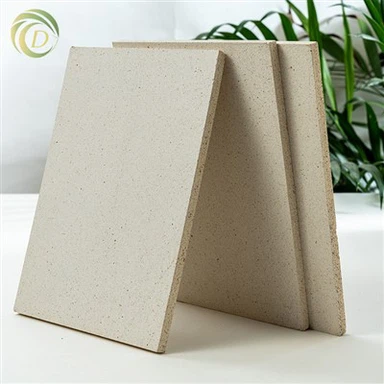
Fire Resistant Board
The fire-resistant properties of MgO boards represent a combination of "inherent non-combustibility, structural stability against high temperatures, and safe smoke control." Their Class A1 combustion performance not only meets fire codes but also provides active protection in real fires by delaying spread, blocking heat, and controlling smoke. This "innate" fire resistance makes them a key choice for replacing organic materials and upgrading fire safety standards in modern building construction.
- Fast Delievery
- Quality Assurance
- 24/7 Customer Service
Product Introduction
The fire resistance of magnesium oxide boards is what makes this material stand out as a high-performance building material. It's not just that the material itself doesn't burn-its fire protection works on multiple levels, like staying stable at high temperatures, controlling smoke, and performing well in real-world use. Let's break this down by looking at how it works, the specific test results, how it performs in actual fires, and the latest tech upgrades:
1. How It Resists Fire: It's Not Just Added Flame Retardant-It's Built-In
The fire resistance of magnesium oxide boards (we often call them GFRP boards too) doesn't come from any external flame retardant chemicals. It's all about the materials they're made of and their molecular structure-basically, it's "naturally non-combustible" right from the start.
First, the inorganic minerals are super heat-resistant. The main ingredients are magnesium oxide (MgO) or magnesium sulfate-these are typical inorganic compounds that can handle high temperatures. Their melting point is as high as 2800℃, which is way hotter than most fires (usually between 800-1200℃). When things get hot, magnesium oxide doesn't catch fire or oxidize. Unlike organic materials like wood or PVC, it doesn't release flammable gases (like methane or formaldehyde) when it gets hot enough to ignite.
Then there's the magnesium-based gel's chemical stability. When magnesium oxide reacts with magnesium chloride (we call this the "magnesium-oxygen reaction"), it forms dense crystal structures-either 5·1·8 phase (5Mg(OH)₂·MgCl₂·8H₂O) or 5·1·7 phase (5Mg(OH)₂·MgSO₂·7H₂O). These structures are really heat-resistant. At high temperatures, they only slowly lose water (releasing harmless water vapor)-they don't break down into flammable stuff, and they don't melt or drip, which would make fires worse.
The reinforcing materials help too. Inside the boards, there's glass fiber cloth (it melts at around 600℃). In the early stages of a fire, this cloth keeps the board intact. Even if the temperature gets higher than 600℃ and the cloth melts, the remaining inorganic frame (from the magnesium gel) still stays stable. That stops the board from cracking, so it doesn't stop working as a fire barrier.
2. The Numbers Prove It: It's Fully Non-Combustible and Meets All Standards
According to China's national standard GB 8624-2012 (Classification of Combustion Performance of Building Materials and Products), magnesium oxide boards have to pass strict tests to reach A1 grade-that's the highest non-combustible rating. Here's what those tests involve, in simple terms:
First, the non-combustibility test (GB/T 5464): We put the board in a furnace at 750℃ ± 50℃ and heat it continuously for 30 minutes. The sample can't burn (no flames, no constant red heat), its mass loss can't be more than 50%, and the temperature rise can't exceed 50℃. In real tests, magnesium oxide boards usually only heat up 10-20℃-way below the limit.
Then the calorific value test (GB/T 14402): The total heat released when it burns (PCS) can't be more than 2.0 MJ/kg, and each test sample can't release more than 1.4 MJ/kg. To put that in perspective, wood releases about 15 MJ/kg, and ordinary gypsum board (A2 grade) releases around 3.0 MJ/kg. The heat from magnesium oxide boards is almost nothing-even in extreme cases, it can't keep a fire going.
There's also the smoke toxicity test (GB/T 20285): When it breaks down or burns at high temperatures, the smoke is at ZA1 grade-that's the safest level. That means when test mice are exposed to the smoke, they don't die or get poisoned. Why? Because the only things it breaks down into are magnesium oxide, magnesium chloride, and water vapor-no deadly gases like carbon monoxide or cyanide.
3. How It Protects in Real Fires: From Just "Not Burning" to Actually "Stopping Fires"
In real fires, magnesium oxide boards work in three key ways-they don't just passively resist fire; they actively help put it under control.
A Physical Barrier to Slow Fire Spread
When used as wall or ceiling materials, they stop flames from getting through directly. For example:
A 12mm thick magnesium oxide board alone can stay intact and keep heat out for over an hour.
If you combine it with light steel keels and 50mm thick rock wool to make a fireproof wall, it can resist fire for up to 3 hours. That's enough to meet the fire safety requirements for important areas like high-rise building core cylinders and fire control rooms.
An Insulation Layer to Block Heat Transfer
The thermal conductivity of magnesium oxide boards is about 0.15 - 0.2 W/(m·K)-that's only 1/500 of steel. In a fire, their dense structure slows down heat moving to the other side, so combustibles on the other side don't get hot enough to ignite. Tests show that if the fire-facing side hits 1000℃, the other side of a 10mm thick board stays below 150℃ for an hour-that's way lower than wood's ignition point of 260℃.
A Safety Feature to Reduce Smoke Dangers
In fires, 80% of deaths and injuries are from toxic smoke. Magnesium oxide boards produce very little smoke when hot (the smoke density rating SDR is ≤ 10) and no irritating smell. Compare that to ordinary plywood, which has an SDR over 80 when burning-the formaldehyde and carbon monoxide it releases can suffocate you in 5 minutes.
4. It Works in All Kinds of Scenarios: From "Meeting Standards" to "Being Useful"
The fire resistance of magnesium oxide boards lets them work in lots of high-risk places, and they still perform well in other practical ways too:
Fire protection in humid environments: Traditional fireproof materials like rock wool or calcium silicate boards absorb water and lose their fire resistance when it's damp. But magnesium oxide boards don't absorb much water-they keep their fireproof performance stable in damp areas like kitchens, bathrooms, and underground garages. That solves the big problem of needing both "moisture resistance" and "fire protection".
Long-term reliability for hidden work: When used to cover ducts or as fireproof coating for steel structures, they don't lose their protection from aging or cracking-unlike regular fireproof coatings. Their inorganic material can handle long-term high temperatures (like heat from machine room equipment) and environmental damage. The fire protection lasts as long as the building itself.
Better performance in composite systems: When you pair them with fireproof sealants and fireproof cotton to make a "multi-layer defense", magnesium oxide boards act as the outer rigid protective layer. They stop flames from directly hitting the inner filling materials, which makes the whole composite system's fire resistance last longer.
About Fire Resistant Board

Application:
Home/Garage/Bathroom/Firewall/Ceiling/Basement/School/Hospital/Restaurant/Office building/Hotel/Indoor and outdoor partitions.

Product Features:
MGO board has good fire performance. I1. Non combustible, with a fire resistance rating of A1.
Higher strength, stronger and more impact-resistant than plywood, particleboard, cement board, gypsum board and other board products.
Anti-corrosion, mildew-proof, insect-proof, ant-proof.
Zero formaldehyde, more environmentally friendly.
Excellent sound insulation.
Simple construction, convenient and fast installation, easy to cut and drill.
High cost performance, light weight, high performance, moderate price.
Water resistant, anti-corrosion, mildew-proof.
Product Parameters:
|
Main Materials |
MgO, MgCl2/MgSO4, Glass fiber Mesh |
|
Fire Performance |
Non-combustible, No flame spread, No smoke spread,No poisonous gas |
|
Density |
0.8-1.35g/cm3, |
|
Flexural Strength |
8-25Mpa |
|
Impact Strength |
≥3.5 kJ/m2 |
|
Moisture Content |
≤8% |
|
Shrinkage |
≤0.3% |
|
Swelling |
≤0.3% |
|
ScrewHolding Capacity |
40-120/(N/mm) |
|
Leachable Chloride |
0.1%(MOS),3%(MOC) |
|
Edge |
Square/T&G/Tapered/Beveled |
|
Thickness |
3-20mm |
|
Standard Sizes |
4*8ft/1.22*2.44m(Other sizes can be customized) |
|
Production Capacity |
5000 square meters / day |
|
Remark |
The above parameters are acceptable to ODM |
About the Factory:
Fire Resistant Board Factory

Our Service:
Our reputation rests on our creative formula design approach, strict quality control, as well as our technical expertise and attention to details to assure consistent products.
Company Advantage (Why Choose Us):
We specialize in quality control and consistency of MgO products. We have actively participated in the development of ASTM standards related to MgO products. We have joined hands with the China Magnesium Industry Association (CMMA), the Magnesium Oxide Building Products Association (MgOBPA) of North America, and the Magnesium Oxide Association (MOCA) to jointly promote the popularization of magnesium oxide cement products in the construction sector.
FAQ:
Q: What is your delivery time?
A: 1 month after receiving the deposit.
Q: What is your payment?
A: T/T 50% deposit and balance payment before shipment.
Q: Can you customize products?
A: Yes, we can cut any size as needed.
Packing And Shipping:
Packaging And Shipping Of Fire Resistant Board

Hot Tags: fire resistant board, China fire resistant board manufacturers, suppliers, factory, polypropylene board, flexible board, flat board, polyester board, magnesium oxide durable wall board, concrete substitute