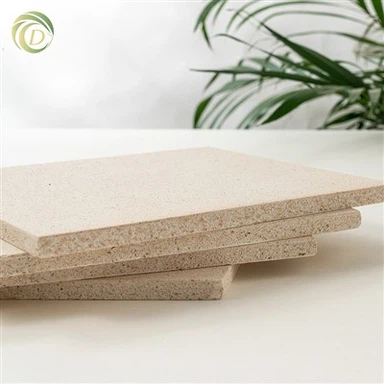
MGO Board: Redefining Construction Standards With Lightweight And High-Strength Performance
Apr 21, 2026
As the global construction industry strides toward efficiency, safety, and sustainability, Magnesium Oxide (MGO) board has emerged as a game-changing building material, revolutionizing project delivery with its exceptional lightweight and high-strength properties. This innovative inorganic composite board is rapidly replacing traditional gypsum, cement, and wood-based panels, becoming the preferred choice for residential, commercial, and industrial construction worldwide.
At the core of MGO board's breakthrough performance is its scientifically engineered composition. Crafted with high-purity magnesium oxide as the base material, combined with alkali-resistant glass fiber cloth, plant fibers, lightweight perlite, and advanced polymer additives, the board forms a three-dimensional network structure through innovative molding processes – a design that delivers the dual advantage of being lightweight yet structurally robust. Unlike conventional building materials that often require trade-offs between weight and strength, MGO board achieves an optimal balance, addressing key pain points in construction.
The lightweight nature of MGO board is a standout feature, significantly enhancing construction efficiency. A 12mm-thick MGO board weighs only 25-28 kilograms per square meter, 25% to 30% lighter than traditional cement wall boards and comparable to gypsum boards while offering far superior strength. This light weight allows for single-person handling, reducing labor costs and accelerating installation timelines – a critical advantage in large-scale projects, high-rise buildings, and modular construction, where transportation and on-site maneuverability are crucial.
Despite its light weight, MGO board boasts exceptional structural strength, thanks to the synergistic effect of its components. The inorganic fibers and magnesium oxide crystals in its structure create a dense, cohesive matrix, giving the board flexural strength of 12-18 MPa – 2 to 3 times that of ordinary gypsum boards – and excellent impact resistance that prevents deformation or cracking. This high strength enables MGO board to be directly used as the load-bearing layer for non-load-bearing partitions, supporting the hanging of light furniture and decorative items without additional reinforcement, further streamlining construction processes.
Beyond its lightweight and high-strength core properties, MGO board offers a suite of complementary advantages that amplify its value in construction. It achieves Class A1 fire resistance (non-combustible) in compliance with global standards, withstanding temperatures of up to 800℃ for 2-3 hours while maintaining structural integrity and releasing no toxic smoke – a critical safety feature for public buildings, hospitals, and residential complexes. Additionally, it exhibits superior moisture and mold resistance, with a water absorption rate of ≤10% and dimensional stability even in high-humidity environments such as bathrooms, basements, and coastal areas, eliminating issues of swelling, mold growth, and wall blackening common with traditional materials.
Industry experts note that MGO board's rise aligns with global construction trends toward sustainability and efficiency. With a low carbon footprint – its CO₂ emissions are only about 45% of concrete – and 100% recyclability, the board meets green building standards such as LEED and BREEAM, making it a sustainable choice for eco-conscious projects. Its long service life, exceeding 50 years, and resistance to corrosion, termites, and aging further reduce long-term maintenance costs, delivering exceptional value over the project lifecycle.
"MGO board's lightweight and high-strength performance is reshaping how we approach construction," said a senior construction materials analyst. "It not only cuts labor and transportation costs but also enhances structural safety and durability, addressing the industry's growing demand for materials that are both efficient and reliable. As building codes become stricter and sustainability becomes a priority, MGO board is poised to become a mainstream material in the global construction sector."
From interior partitions and ceilings to exterior sheathing, tile backers, and modular construction components, MGO board's versatility makes it suitable for a wide range of applications. Its ease of processing – compatible with sawing, nailing, drilling, and painting – further simplifies installation, making it a favorite among contractors and architects alike. With the global MGO board market projected to grow at a CAGR of 5.35% from 2024 to 2032, reaching USD 2.62 billion by 2032, the material's impact on the construction industry is set to expand exponentially.
As innovation in MGO board formulations and manufacturing processes continues, the material is expected to push the boundaries of construction performance, offering even greater strength-to-weight ratios and adaptability. For the construction industry, MGO board is more than a new material – it is a catalyst for safer, more efficient, and more sustainable building practices.