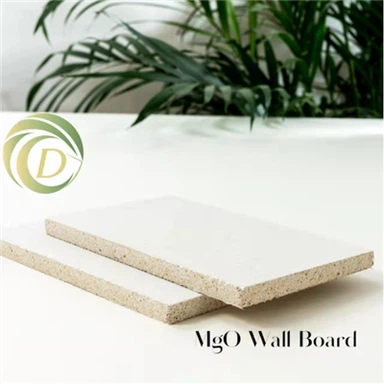
Core Knowledge on Efflorescence & Salt Bleeding of Magnesium Oxide Boards (Magnesium Oxide Board Efflorescence)
Jun 08, 2026
1. Basic Definition of Salt Bleeding
Salt bleeding (also known as sweating, weeping or efflorescence) is the most common quality defect of magnesium oxychloride boards (MgO boards). Under humid conditions and temperature & humidity fluctuations, soluble internal salts migrate to the board surface through capillary water, forming sticky water droplets, white salt deposits and sticky surfaces. In severe cases, surface mildew, dust adhesion and peeling may occur.
Different from ordinary surface dampness, salt bleeding is a persistent defect caused by internal chemical residues. Simple ventilation and air drying cannot completely solve the problem, and the defect is highly recurrent.
2. Mechanism of Salt Bleeding
Magnesium oxide boards are mainly composed of light-burned magnesium oxide (MgO), magnesium chloride solution (MgCl₂), water and fillers. During normal curing, stable 5·1·8 phase crystals (5Mg(OH)₂·MgCl₂·8H₂O) are formed, which constitute the core structure for the board's strength and stability.
The fundamental cause of salt bleeding is incomplete curing reaction and excessive residual free magnesium chloride (free chloride ions) inside the board. Magnesium chloride is highly hygroscopic. In high-humidity environments, it absorbs moisture from the air to form saline solution, which continuously penetrates and precipitates on the board surface through internal capillary pores, resulting in salt bleeding.
Core formula: Residual free chloride ions + Humid environment = Salt bleeding. Excessive free chloride ions are the essential internal cause, while temperature and humidity changes are the inducing external cause.
3. Classification of Salt Bleeding (On-site Rapid Judgment)
Mild Salt Bleeding: Slight surface dampness in rainy and humid weather with no obvious water droplets. A small amount of white salt frost appears after drying, with flat surface and no stickiness.
Moderate Salt Bleeding: Dense water droplets continuously form on the surface in humid conditions with obvious stickiness. Thick white salt frost remains after drying, causing easy dust adsorption, surface contamination and slight color difference.
Severe Salt Bleeding: Large-area water accumulation and dripping with strong surface viscosity. Accompanied by mildew, blackening and peeling, the board's adhesion drops sharply, leading to complete failure of subsequent painting and veneering, and even corrosion of steel keels and metal fasteners.
4. Root Causes of Salt Bleeding (Full-scenario Analysis)
4.1 Imbalanced Formula Ratio (Primary Cause)
The optimal industry molar ratio of magnesium oxide to magnesium chloride is 7–9:1, which ensures sufficient chemical reaction and stable formation of 5·1·8 phase crystals.
Common errors include excessive or over-concentrated magnesium chloride solution, and arbitrary addition of brine or water to adjust slurry consistency. These practices break the balance of the reaction system, leaving a large amount of unreacted magnesium chloride inside the board. Excessive fillers will also reduce reaction uniformity and aggravate residual free salts.
4.2 Unqualified Raw Material Quality
Insufficient activity or moisture-induced failure of light-burned magnesium oxide is a frequent inducing factor. Low-activity magnesium oxide cannot fully bind chloride ions, resulting in incomplete reactions even with a standard numerical ratio. In addition, magnesium oxide absorbs moisture during storage and converts into magnesium hydroxide, completely losing chemical activity and causing excess residual chloride ions.
4.3 Defective Production Processes
Uneven stirring: Local enrichment of magnesium chloride causes hidden salt bleeding risks.
Improper curing: Insufficient curing temperature, humidity or curing period leads to incomplete crystallization, increased unstable 3·1·8 phase impurities, loose structure and large pores, which facilitate salt penetration and bleeding.
Excessive molding moisture content: Excess free water inside the board provides channels for salt migration.
4.4 Adverse Service Environment
Boards qualified after factory delivery may develop delayed salt bleeding if used in long-term high-humidity environments such as basements and kitchens & bathrooms. Sealing, veneering or painting before thorough drying traps internal moisture and accelerates salt migration and precipitation.
5. Hazards of Salt Bleeding
Decoration Failure: Sticky and whitened board surfaces cause blistering, peeling and discoloration of latex paint, stone paint, stickers and fire-retardant veneers.
Metal Corrosion: Precipitated weak-acid saline solution corrodes light steel keels, screws and fasteners, leading to rusting, loosening and reduced structural stability.
Degraded Board Performance: Continuous salt bleeding destroys the internal crystal structure, causing softening, strength reduction, warping, pulverization and cracking of the board.
Mold Growth and Odor: Humid and salty surfaces are prone to black mildew and peculiar odors, deteriorating indoor environmental hygiene.
High Rework Risk: As a non-self-healing persistent defect, salt bleeding leads to extremely high later-stage project rework costs.
6. Comprehensive Prevention and Control Solutions (Fundamental Remediation)
6.1 Raw Material and Formula Control (Source Prevention)
Strict raw material inspection: Adopt qualified light-burned magnesium oxide with activity ≥ 60% and test activity regularly; reject damp and deteriorated materials. Use high-purity stable magnesium chloride and avoid inferior industrial brine.
Precise proportioning: Strictly follow the magnesium-chloride molar ratio of 7–9:1, dynamically adjust the formula according to real-time MgO activity, and prohibit arbitrary brine addition for slurry thinning.
Special modifier addition: Adopt composite organic and inorganic anti-bleeding modifiers to stabilize the crystal structure via ion replacement and physically block capillary pores to cut off salt migration channels.
6.2 Production Process Optimization (In-process Control)
Ensure sufficient and homogeneous stirring to eliminate local salt enrichment and ensure uniform reaction.
Strictly control moisture content to avoid excessive free water and reduce capillary penetration channels.
Standard curing: Cure under appropriate temperature and humidity to fully form stable 5·1·8 phase crystals and reduce unstable impurity phases.
6.3 Construction and Storage Protection (Post-processing Prevention)
Store boards in dry and ventilated areas with elevated stacking to avoid ground moisture, rain and condensation.
Suspend surface sealing and finishing when construction ambient humidity exceeds 80% to ensure thorough drying and internal moisture volatilization.
Apply professional anti-bleeding primer on boards used in humid areas to seal capillary pores and block salt precipitation.
7. Emergency Treatment for Salt-Bleeding Boards
Mild Salt Bleeding: Conduct thorough ventilation and drying, wipe off surface salt frost with dry cloth, and apply alkali-resistant and anti-bleeding primer before subsequent finishing works.
Moderate Salt Bleeding: Dry the board completely, polish and remove surface salt and sticky layers, apply two coats of sealing primer to block continuous internal salt precipitation, and confirm no re-bleeding before construction.
Severe Salt Bleeding: The internal crystal structure is permanently damaged with irreversible performance degradation.Direct replacement is recommended, as repairs cannot eliminate recurrent bleeding risks.
8. Common Misconceptions
Misconception 1: Salt bleeding is only surface dampness and can be solved by air drying. Correction: Ordinary dampness is self-healable, while salt bleeding stems from internal residual salts and will recur in humid conditions. Fundamental structural sealing and chemical stabilization are required.
Misconception 2: A standard numerical ratio guarantees no salt bleeding. Correction: The formula must be dynamically adjusted based on real-time MgO activity. Fixed ratios fail to ensure complete reaction when raw material activity declines.
Misconception 3: Thick topcoat paint can cure salt bleeding permanently. Correction: Single surface coating cannot block internal salt migration. Salts will penetrate and blister the paint film over time.
Misconception 4: Boards with no initial bleeding are qualified. Correction: Delayed salt bleeding is common. Boards with insufficient curing or excessive moisture will develop obvious bleeding 1–3 months after service in humid environments.
9. Core Summary
The essential causes of magnesium oxide board salt bleeding are internal excessive free chloride ions and unstable crystal structure, with high ambient humidity as the external inducing factor. The fundamental prevention principle relies on source formula control, in-process process optimization, post-construction environmental management and graded defect treatment. Late remedial repairs cannot achieve radical solutions; pre-control of raw materials and production processes is the key to eliminating salt bleeding.